An AI-Assisted Workflow for Creating Scientific Animations
中文
Turning scientific concepts into short, code-driven films. This project combines human scientific framing, creative direction and review with AI-assisted implementation. Finished animations, editable source and production notes show how an explanation becomes a visual work.
The approach: understand the mechanism → design the visual explanation → review and revise → render from code.
First film · Electric-double-layer gating
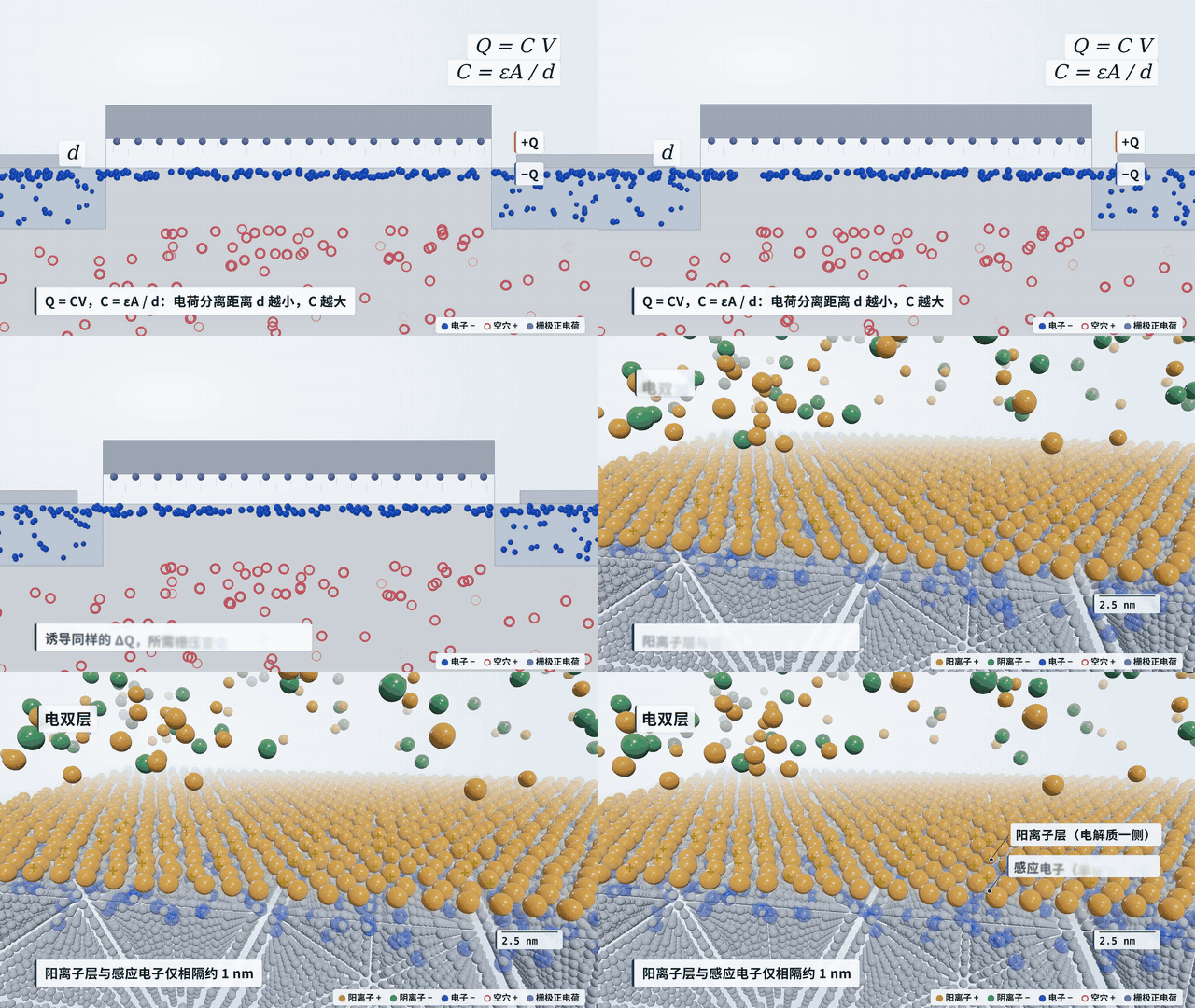
FULL FILM · 2:26 · 1080p / 30 fps · Music & sound effects
Chinese on-screen graphics, with optional English explanation subtitles. The animation above is a short, silent preview; the selected full-quality film is 95.48 MB.
Background: the topic comes from a lecture in an undergraduate sensors course. It was not an assignment. Inspired by the recent wave of programmatic films made with Claude Opus, the creator took it up as a self-directed project to explore AI-assisted scientific animation, and went as far as discarding a complete first version to rebuild the film from scratch (see below).
The question: how can a larger gate capacitance achieve the same change in channel charge at a lower gate voltage?
The film follows one device from a two-dimensional cross-section into a three-dimensional electrolyte interface, then returns to compare two gating schemes. It explains established course physics through a continuous visual narrative.
Ion redistribution → closely separated interface charges → larger effective capacitance → less gate voltage for the same ΔQ.
The comparison does not imply weaker local interface fields or a higher intrinsic material breakdown strength. Geometry, particles, field lines and the defect path are explanatory illustrations.
How review shaped the result
The creator organized the scientific content, set the visual direction and reviewed successive versions. A web GPT conversation helped develop the brief; Grok Bot, which was announced in October 2026 to route tasks to back-end models including Claude Opus 5.5, assisted with scene code, captions, synthesized music and sound effects, and rendering. Human review connected the scientific meaning to concrete changes in the film.
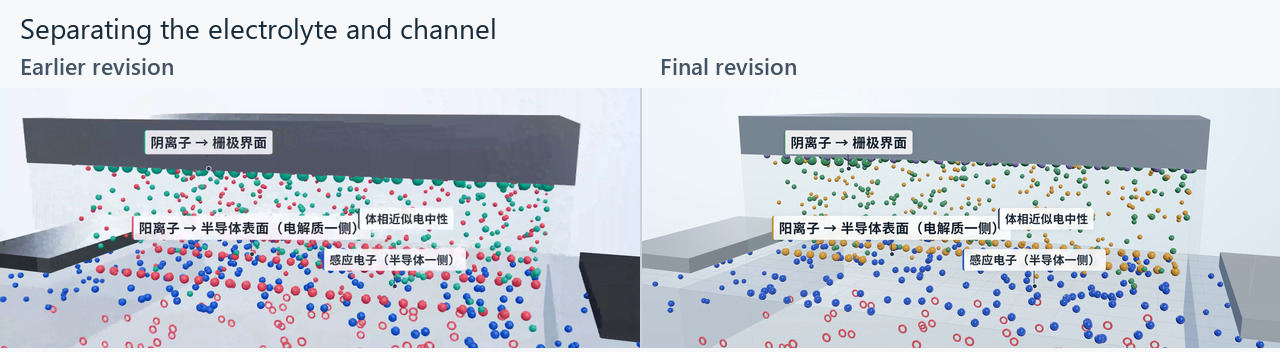
An example of actionable review: cut back the upper electrolyte, reveal the interface grid, and separate charge colors. These frames show the corresponding narrative phase in two revisions.
| A production decision |
What changed in the film |
| Give the camera a physical purpose. An early 5:40 narration-led version felt like presentation slides. |
A new 1–3 minute brief followed one device through 2D → 3D → the microscopic interface, with text and sound supporting its motion. |
| Separate overlapping physical regions. The electrolyte hid the interface and channel. |
A front cutaway, interface grid and distinct charge colors made the spatial relationship easier to read. |
| Keep clarity while tightening the pace. Long reading intervals and glare interrupted the explanation. |
Revised captions, camera timing, materials and sound produced a 2:26 film, with more visible schematic breakdown. |
These are decisions from this case, not fixed settings for every animation. Further films can explore other principles, devices and applications.
From scientific explanation to editable implementation
| Frame the science |
Direct and review |
Implement and render |
| Distinguish gate control from source–drain transport. Compare the same target charge, and state the limits of the failure-risk argument. |
Write a visual brief, inspect frames and sequences, and turn observations about depth, color and timing into specific changes. |
Use time-driven Three.js scenes and DOM captions, Puppeteer frame capture, NumPy/SciPy sound synthesis and FFmpeg encoding. |
In the EDL case, a shared story-to-film timeline keeps captions, camera motion and sound events aligned. Frames can be generated at chosen times; source and rendering tools are included so the work can be inspected and modified.
Source, production notes and reproduction details
The supplied full film has 4,383 frames. The updated tools cover the complete scene; full-film re-rendering and exact historical output equivalence have not been established. The production tools are recorded; the specific model backend is not. Full private conversations and local environments are excluded.
Code: MIT · Original films, audio, images and writing: CC BY 4.0 · Sources and credits